


HubSpot Competitors: 7 Alternatives for Startups in 2026
HubSpot is one of the most recognizable names in CRM and marketing automation. Its free CRM is genuinely useful, and for many startups, it's the first serious tool they adopt for managing contacts and deals.
But HubSpot's pricing model has a catch that hits growing startups hard. The free plan works well — until you need features like automation, custom reporting, or advanced lead scoring. Then you're looking at $890/month for Marketing Hub Professional or $90/user/month for Sales Hub Professional. Add onboarding fees (starting at $3,000 for Pro plans) and mandatory annual contracts, and the total cost can spiral quickly.
That's why many startups start looking at HubSpot competitors once they outgrow the free tier. This guide compares 7 alternatives that are realistic for startups — focusing on honest pricing, what each tool does better than HubSpot, and where it falls short.
Why Startups Look for HubSpot Competitors
Before diving into alternatives, it helps to understand the specific pain points that push startups to switch:
Pricing escalation. HubSpot's Starter plan is $20/month, which is reasonable. But the jump to Professional is dramatic — $890/month for Marketing Hub, $90/user/month for Sales Hub. For a 5-person startup, that's $5,000-6,000/year just for sales CRM at the Professional tier.
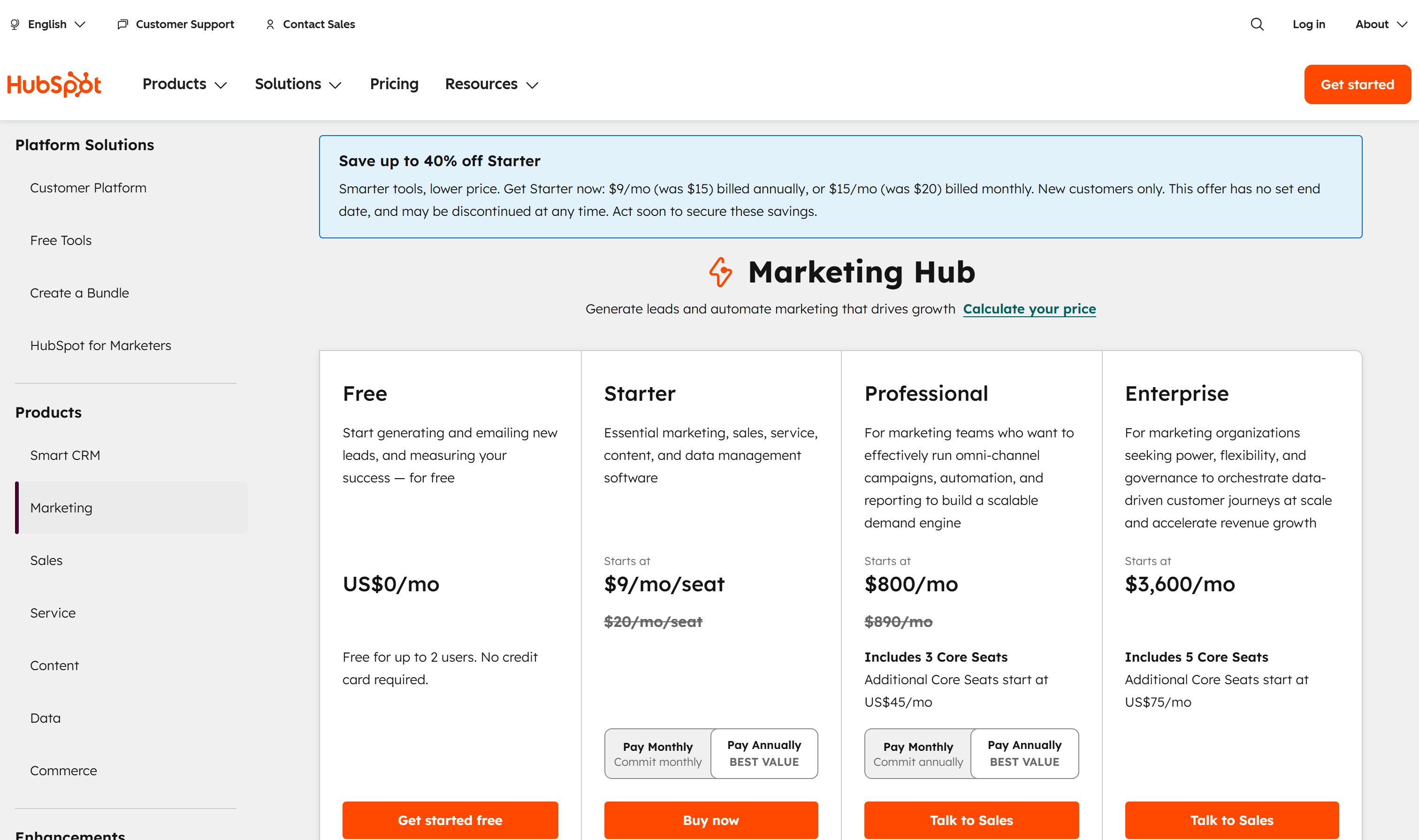 Image credit: HubSpot
Feature gating. Key features like A/B testing, custom reporting, predictive lead scoring, and marketing automation are locked behind Professional or Enterprise plans. You often don't realize you need them until you've already built your workflow around HubSpot's free tier.
Contact-based pricing. HubSpot's Marketing Hub charges based on the number of marketing contacts. As your email list grows, costs increase — even if your revenue hasn't caught up yet.
Annual contracts. Paid plans require a 12-month commitment. If HubSpot isn't the right fit after a few months, you're still paying for the full year.
None of this means HubSpot is bad. If you have the budget for Professional plans and your team is invested in the HubSpot ecosystem, it's a powerful platform. But for budget-conscious startups, the cost-to-value ratio often doesn't work.
7 HubSpot Competitors for Startups
1. Pipedrive — Best for Sales-Focused Teams
Pipedrive is a CRM built around visual pipeline management. It does one thing extremely well: helping salespeople track and close deals. Unlike HubSpot, which tries to be an all-in-one platform, Pipedrive focuses on the sales process.
Where it beats HubSpot: Simpler interface, more affordable advanced features, and visual pipeline management that's intuitive from day one. You get features like email sequences, automation, and custom reports at a fraction of HubSpot's Professional pricing.
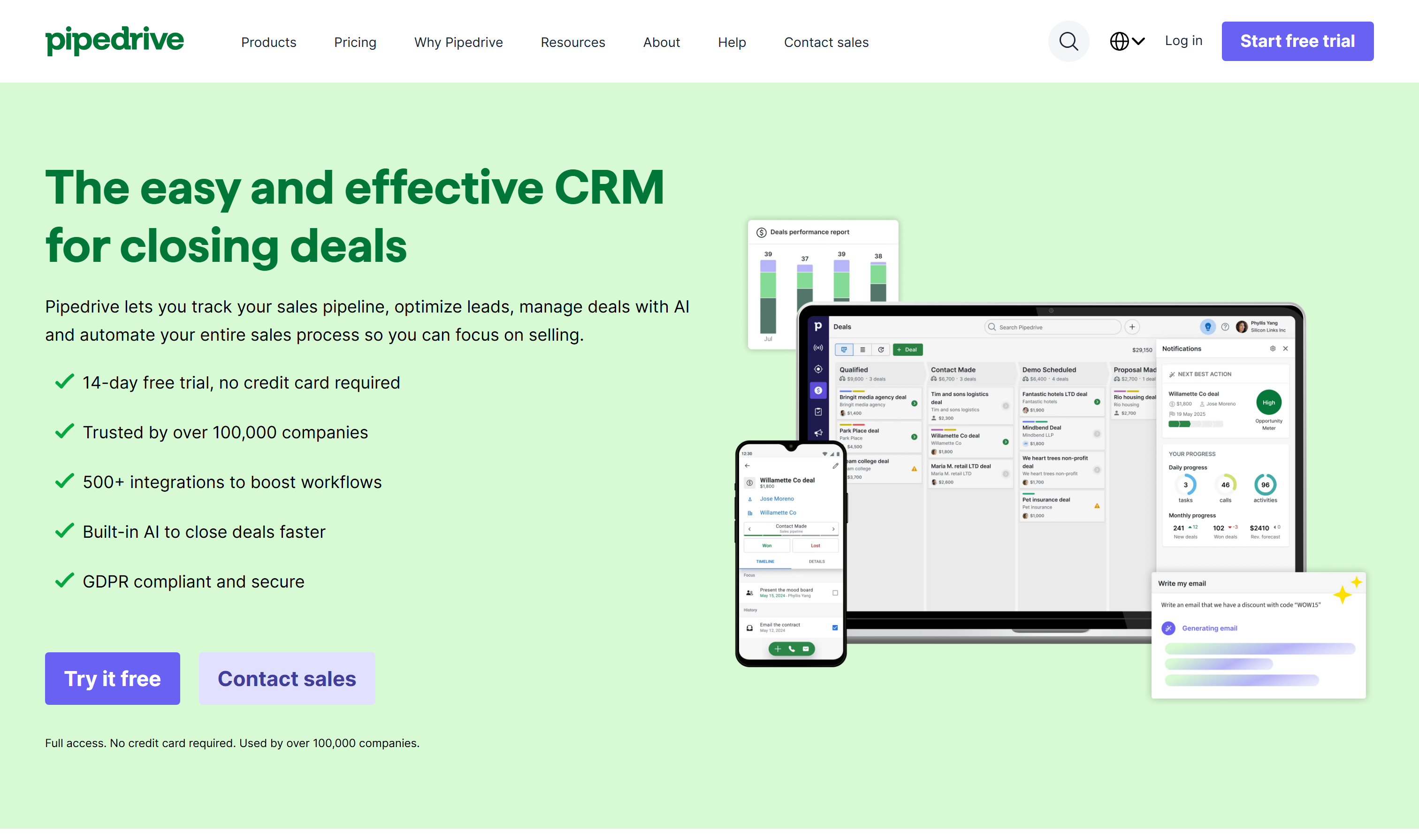 Image credit: Pipedrive
Where HubSpot wins: Marketing tools. Pipedrive has basic email marketing but nothing close to HubSpot's Marketing Hub. If you need landing pages, blog hosting, or inbound marketing automation, Pipedrive isn't the answer.
Pricing: Essential at $14/user/month, Advanced at $29/user/month, Professional at $49/user/month, Power at $64/user/month. No mandatory annual contracts on most plans.
Best for: Startups with 2-10 salespeople who need a focused, affordable CRM without marketing bells and whistles.
2. Zoho CRM — Best Budget All-in-One
Zoho CRM offers a similar breadth of features to HubSpot — sales, marketing, support, and analytics — but at significantly lower price points. It's part of the larger Zoho ecosystem (50+ apps), which means you can add email marketing, project management, and accounting without leaving the platform.
Where it beats HubSpot: Price-to-feature ratio. Zoho's Professional plan ($23/user/month) includes features that require HubSpot's Professional tier ($90/user/month). The Zoho ecosystem also means you can build a complete business stack at a fraction of HubSpot's cost.
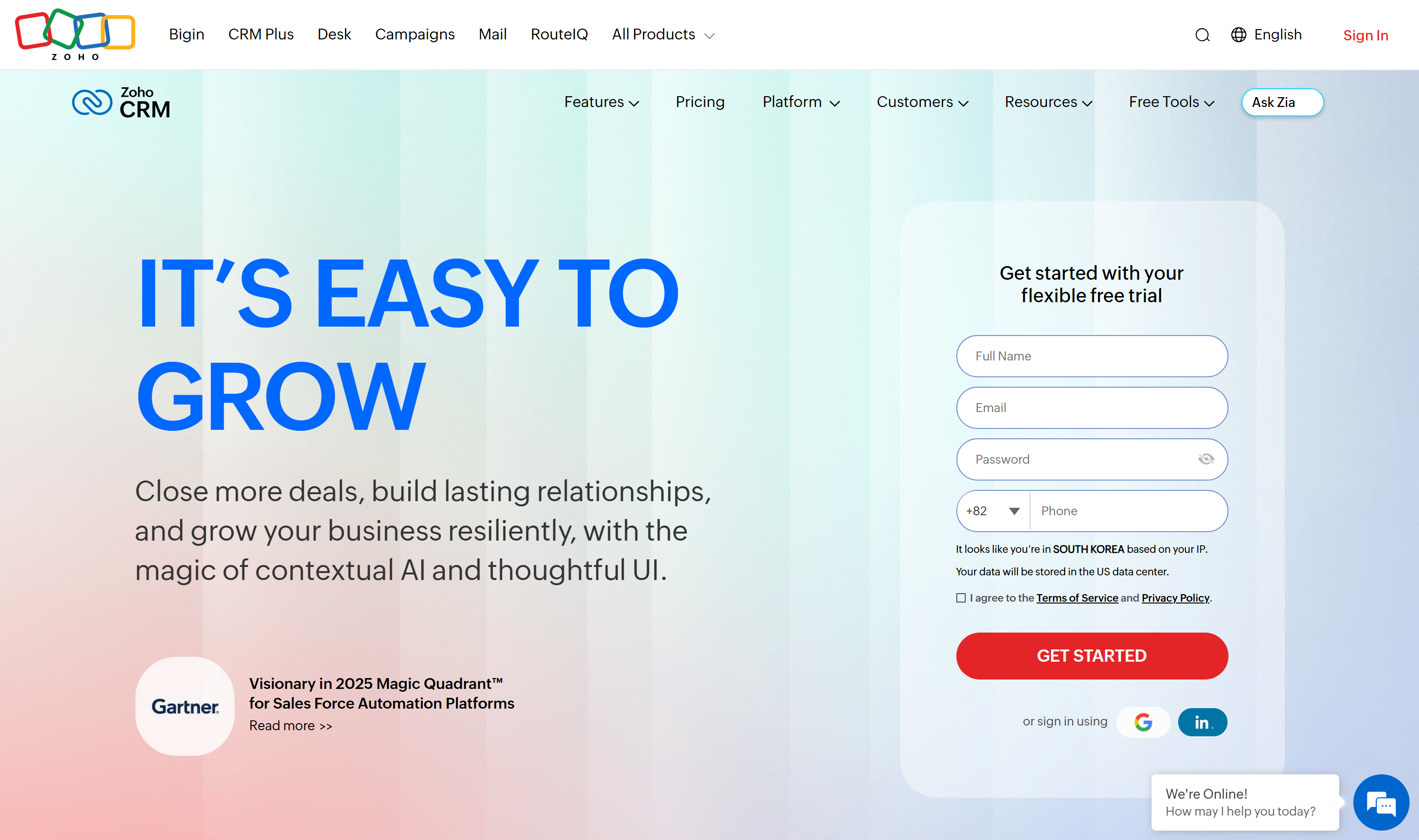 Image credit: Zoho
Where HubSpot wins: User experience. HubSpot's interface is cleaner and more intuitive. Zoho's breadth of features comes at the cost of a steeper learning curve and an interface that can feel cluttered.
Pricing: Free plan for up to 3 users. Standard at $14/user/month, Professional at $23/user/month, Enterprise at $40/user/month.
Best for: Budget-conscious startups that need CRM + marketing + support in one ecosystem and are willing to invest time in setup and learning.
3. ActiveCampaign — Best for Email Marketing Automation
ActiveCampaign started as an email marketing platform and added CRM capabilities. If your startup's growth engine is email marketing and you need sophisticated automation, ActiveCampaign is a strong HubSpot competitor.
Where it beats HubSpot: Automation builder. ActiveCampaign's visual automation workflows are more flexible and powerful than HubSpot's at comparable price points. You can build complex multi-step sequences with conditional logic, lead scoring, and CRM triggers without paying enterprise prices.
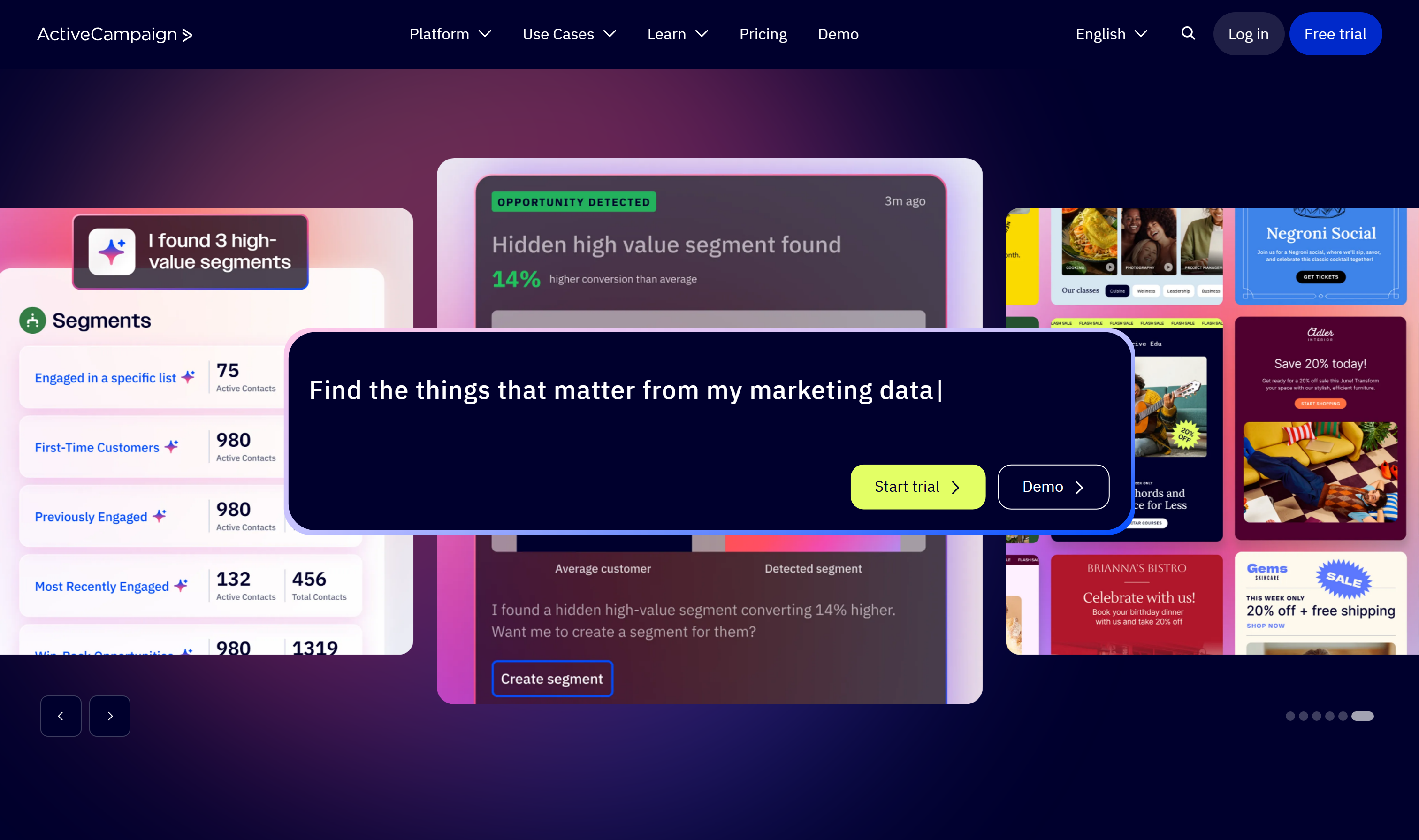 Image credit: ActiveCampaign
Where HubSpot wins: CRM depth. ActiveCampaign's CRM is functional but basic compared to HubSpot's Sales Hub. If deal management and sales pipeline are your priority, HubSpot (or Pipedrive) is stronger.
Pricing: Starter at $15/month (1,000 contacts). Plus at $49/month adds CRM and landing pages. Professional at $79/month adds predictive sending and split automations.
Best for: Content-driven startups and SaaS companies where email nurturing and marketing automation are the primary growth channels.
4. Freshsales — Best for AI-Powered Lead Scoring
Freshsales (by Freshworks) is a CRM with built-in AI that scores and prioritizes leads automatically. It combines contact management, email tracking, and phone capabilities in a clean interface.
Where it beats HubSpot: AI lead scoring is available on lower-tier plans. Freshsales' Freddy AI predicts which leads are most likely to convert, suggests next actions, and automates follow-ups — features that require HubSpot Professional or Enterprise.
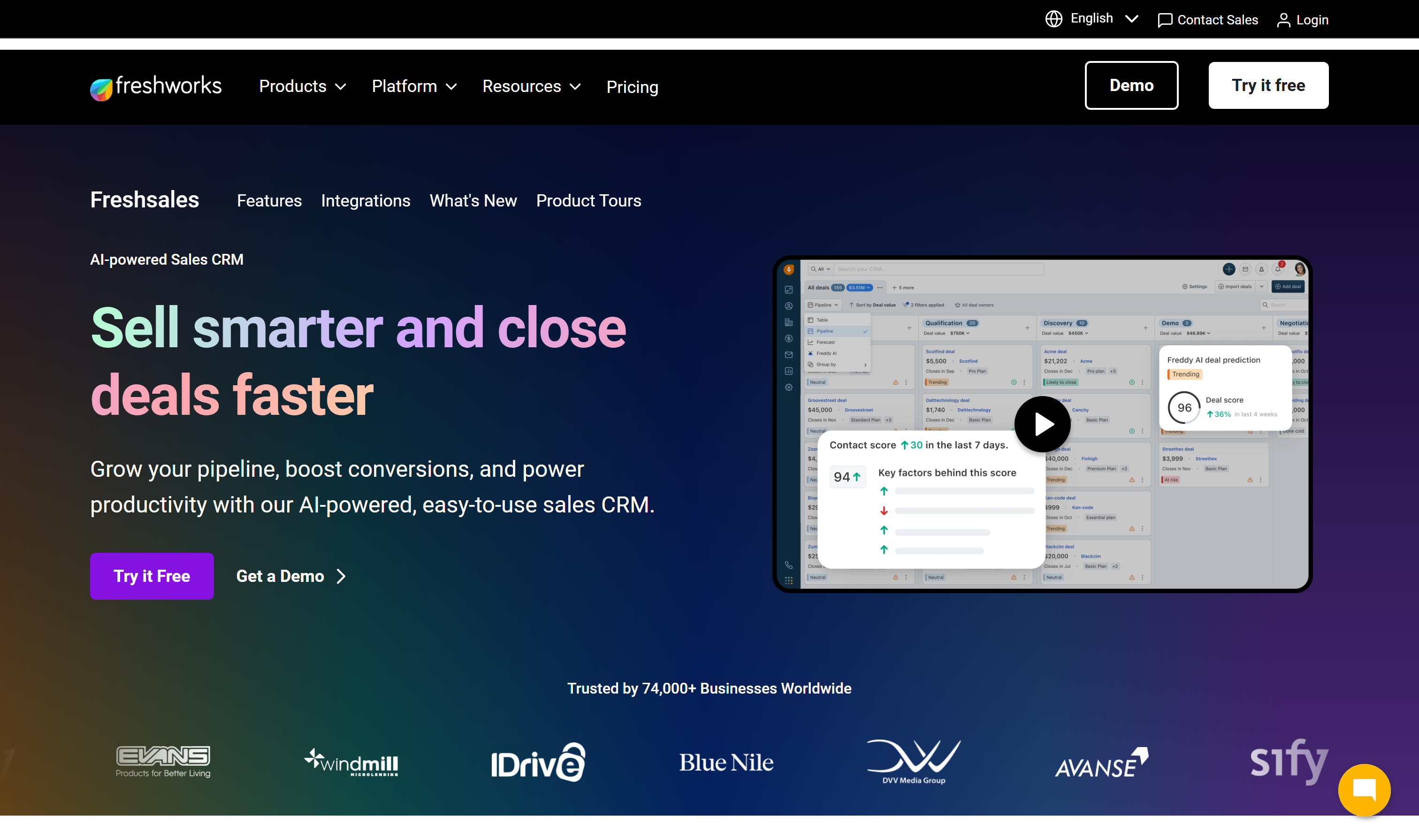 Image credit: Freshworks
Where HubSpot wins: Marketing ecosystem. Freshsales focuses on the sales side. For marketing automation, you'd need Freshmarketer (a separate product), which adds cost and complexity.
Pricing: Free plan with basic features. Growth at $9/user/month, Pro at $39/user/month, Enterprise at $59/user/month.
Best for: Startups that need a sales CRM with strong AI capabilities at an affordable price. Especially good for teams that handle high lead volumes and need automated prioritization.
5. Brevo (formerly Sendinblue) — Best for Transactional + Marketing Email
Brevo combines email marketing, SMS marketing, CRM, and transactional email in one platform. It's particularly strong for startups that need both marketing campaigns and transactional messaging (order confirmations, password resets, etc.).
Where it beats HubSpot: Transactional email is built in — HubSpot charges extra for it. Brevo's pricing is based on email volume, not contacts, so you can have unlimited contacts on every plan. This makes a massive difference for startups building large email lists.
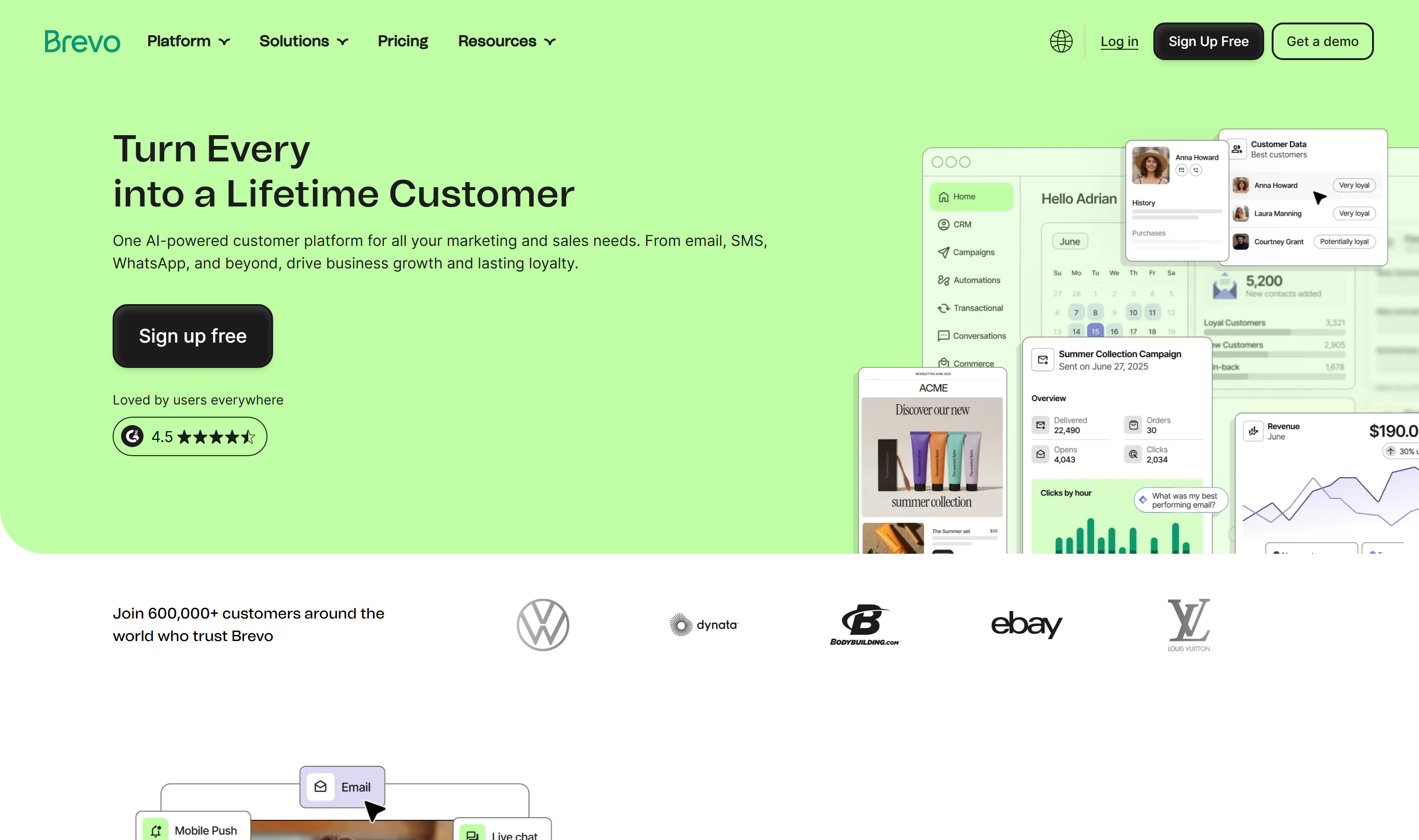 Image credit: Brevo
Where HubSpot wins: CRM sophistication. Brevo's CRM is basic — fine for small teams but lacking the pipeline management and reporting depth of HubSpot or Pipedrive.
Pricing: Free plan with 300 emails/day. Starter at $9/month (5,000 emails). Business at $18/month (unlimited contacts, marketing automation).
Best for: E-commerce startups and SaaS companies that need email marketing + transactional email in one affordable tool. Also good for startups with large contact lists where HubSpot's contact-based pricing would be expensive.
6. Close — Best for Inside Sales Teams
Close is a CRM built specifically for inside sales teams. It has built-in calling, SMS, and email — no integrations needed. If your sales process is phone-heavy, Close eliminates the need for a separate calling tool.
Where it beats HubSpot: Built-in VoIP calling and power dialer. Close lets you make calls directly from the CRM, record them, and log everything automatically. HubSpot offers calling too, but with stricter limits on lower tiers and less sophisticated dialing features.
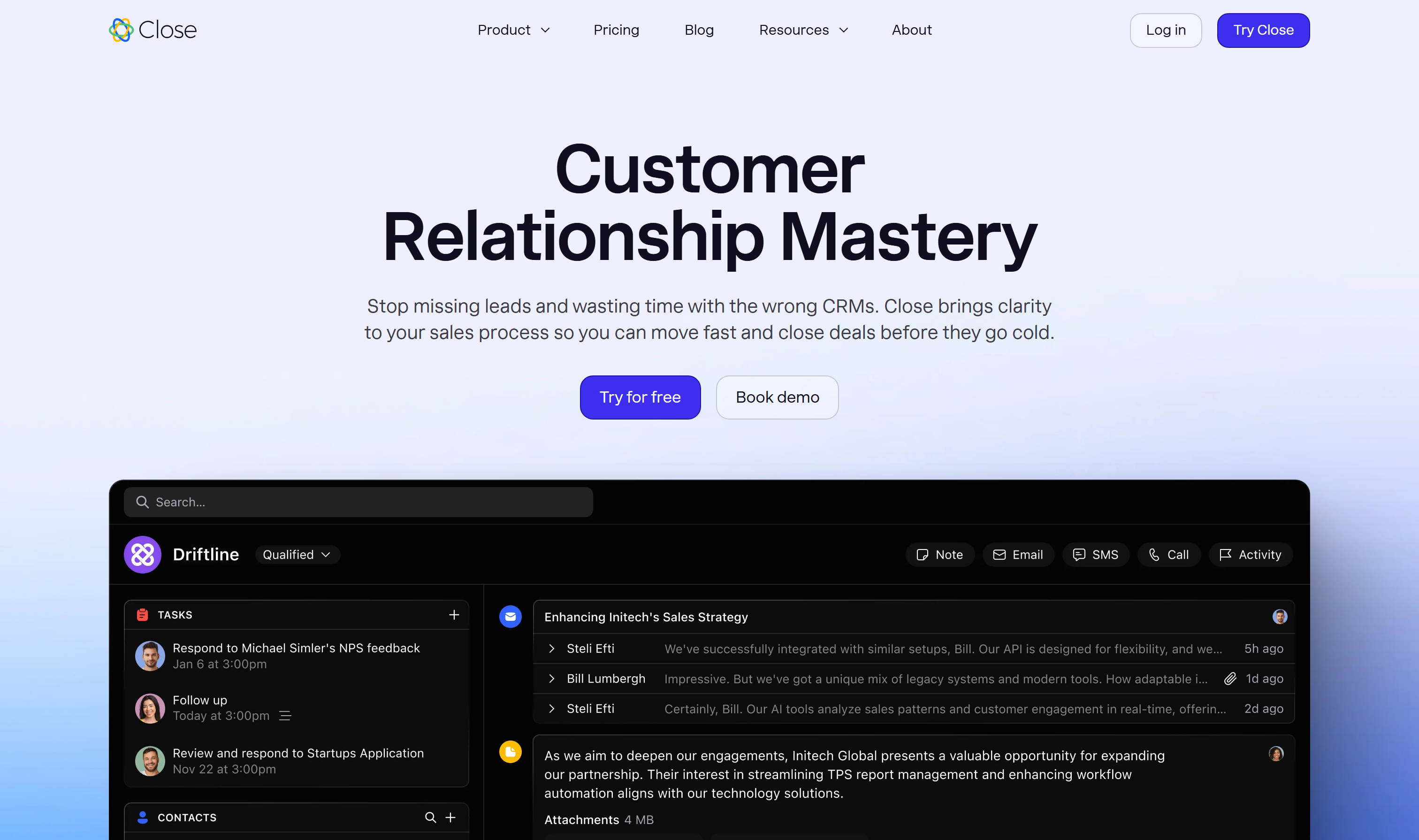 Image credit: Close
Where HubSpot wins: Marketing features and ecosystem breadth. Close is purely a sales tool with no marketing automation capabilities.
Pricing: Startup at $49/user/month (3 users minimum). Professional at $99/user/month. Enterprise at $139/user/month.
Best for: Startups where outbound calling is a core part of the sales process. B2B sales teams that make 20+ calls per day.
7. EngageBay — Best Affordable HubSpot Clone
EngageBay is the closest thing to a budget HubSpot. It offers marketing automation, CRM, helpdesk, and live chat in one platform — at a fraction of HubSpot's price.
Where it beats HubSpot: You get the all-in-one experience — email marketing, landing pages, CRM, helpdesk, live chat — starting at $12.74/user/month. Features that require HubSpot's Professional tier ($890+/month) are available on EngageBay's Growth plan ($49.99/user/month).
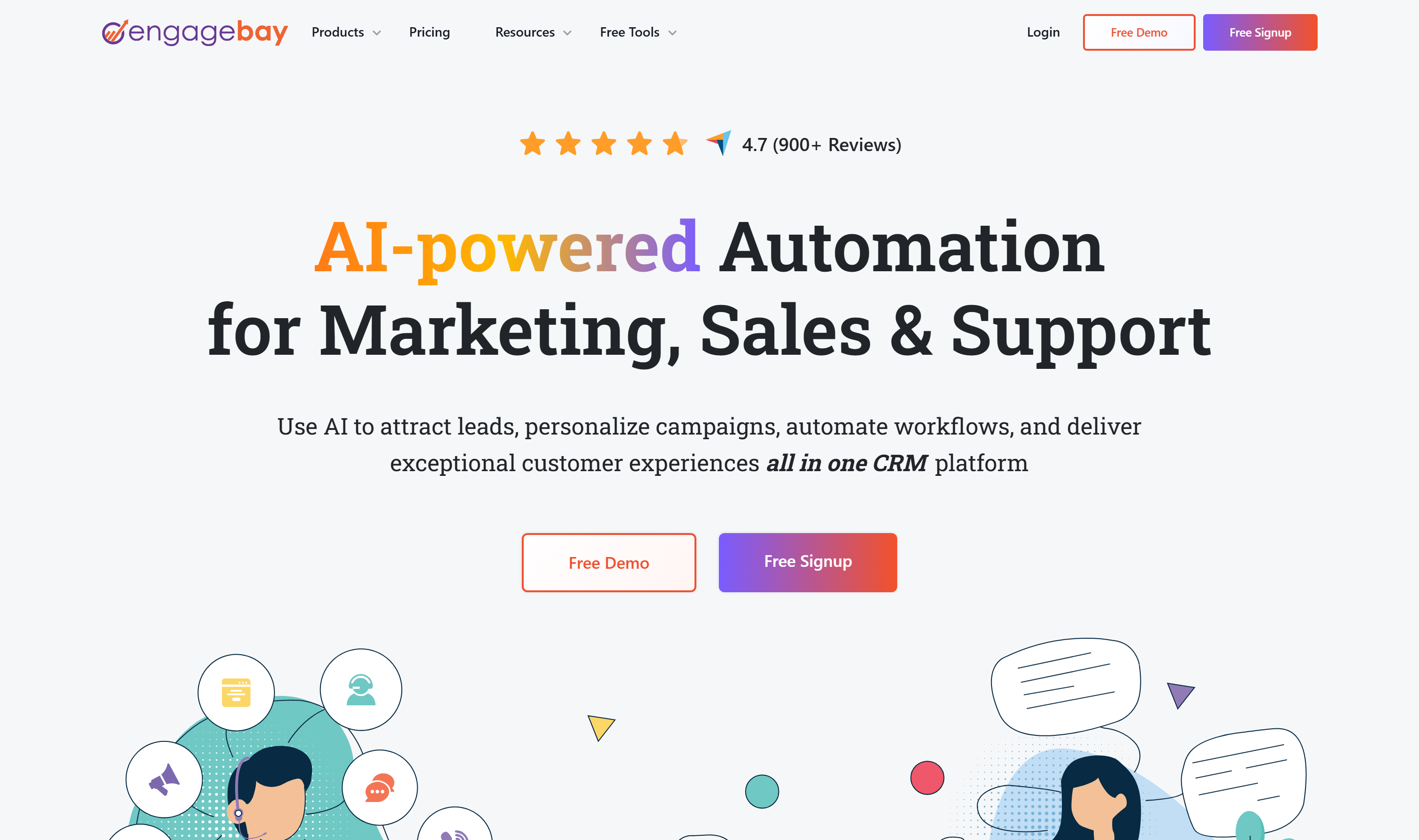 Image credit: EngageBay
Where HubSpot wins: Polish, ecosystem, and integrations. EngageBay works, but the interface isn't as refined, the template library is smaller, and the integration marketplace is limited compared to HubSpot's 1,500+ app marketplace.
Pricing: Free plan for 250 contacts. Basic at $12.74/user/month, Growth at $49.99/user/month, Pro at $79.99/user/month.
Best for: Early-stage startups that want an all-in-one marketing and sales platform without HubSpot's price tag. Good for teams that prioritize functionality over polish.
Quick Comparison
| Competitor | Best For | Free Plan | Paid From | CRM | Marketing | All-in-One |
|---|---|---|---|---|---|---|
| Pipedrive | Sales pipeline | No | $14/user | 5/5 | 2/5 | No |
| Zoho CRM | Budget all-in-one | Yes (3 users) | $14/user | 4/5 | 3/5 | Yes |
| ActiveCampaign | Email automation | No | $15/mo | 3/5 | 5/5 | Partial |
| Freshsales | AI lead scoring | Yes | $9/user | 4/5 | 2/5 | No |
| Brevo | Email + transactional | Yes | $9/mo | 2/5 | 4/5 | Partial |
| Close | Inside sales | No | $49/user | 4/5 | 1/5 | No |
| EngageBay | Affordable all-in-one | Yes (250 contacts) | $12.74/user | 3/5 | 3/5 | Yes |
How to Choose the Right HubSpot Competitor
The right choice depends on what you need most. Here's a quick decision framework:
"I just need a sales CRM." → Pipedrive or Freshsales. Both are focused, affordable, and don't overwhelm you with marketing features you won't use.
"I need CRM + email marketing." → ActiveCampaign (if email automation is your priority) or Brevo (if you also need transactional email).
"I want everything HubSpot offers, but cheaper." → Zoho CRM or EngageBay. Both offer all-in-one platforms at a fraction of the cost, with trade-offs in polish and integrations.
"My team lives on the phone." → Close. Built-in calling, power dialer, and SMS make it the strongest option for outbound sales teams.
"I'm happy with HubSpot's free CRM." → Then stay. HubSpot's free tier is genuinely competitive. Only switch if you've hit the limits of the free plan and the Professional pricing doesn't fit your budget.
For a broader look at AI-powered sales tools that complement any CRM, check out our guide to AI sales tools for small teams.
Key Takeaways
- HubSpot's free CRM is excellent, but pricing jumps sharply once you need Professional features — $890/month for Marketing Hub, $90/user/month for Sales Hub.
- Match the tool to your primary need. Don't buy an all-in-one platform if you only need a sales CRM. Pipedrive at $14/user/month beats HubSpot Professional at $90/user/month for pure sales management.
- Contact-based pricing adds up fast. If you have a large email list, consider Brevo (unlimited contacts) or ActiveCampaign (contact-based but cheaper) over HubSpot's Marketing Hub.
- Zoho and EngageBay offer the broadest feature sets at the lowest prices, but expect a steeper learning curve and less polished interfaces.
- Switching CRMs is painful. Before committing to any platform, map out which features you'll actually use in the next 12 months. Paying for capabilities you won't touch for years is wasted budget.