



SEO for Startups: The Complete Guide to Organic Growth
Paid ads stop working the moment you stop paying. SEO doesn't. For startups with limited budgets, that difference is everything.
SEO for startups is the process of optimizing your website to rank in search engines, attract organic traffic, and convert visitors into users or customers — without spending money on ads for every click. When done right, it becomes a compounding growth channel: content you publish today can drive traffic for years.
But most SEO advice is written for established companies with dedicated marketing teams and six-figure budgets. Startups face a different reality — new domains with zero authority, tiny teams, and the pressure to show results fast while building a product.
This guide is built for that reality. It covers everything a founder needs to know about SEO for startups: when to start, what to prioritize, how to create content that ranks, and how to build authority from zero. Whether you handle SEO yourself or hire help, this guide gives you the strategic foundation to make informed decisions.
Why SEO Matters More for Startups Than Established Companies
Startups have a unique advantage with SEO that most founders don't realize: you can target niches that big companies ignore.
Compounding returns. Every blog post, landing page, and technical improvement you make adds to your organic visibility. Unlike paid channels where costs increase as you scale, SEO costs stay relatively flat while traffic compounds. A blog post you write in month 3 can still drive leads in month 36.
Niche targeting. Established competitors go after high-volume keywords with massive competition. Startups can target long-tail keywords — specific phrases with lower volume but higher purchase intent. "Project management tool for remote design teams" is less competitive than "project management software" but attracts a much more qualified audience.
Trust building. Ranking on the first page of Google signals credibility. For a startup with no brand recognition, appearing in search results alongside established competitors tells potential customers you're a legitimate player.
Cost efficiency. According to Google's Economic Impact Report, businesses typically earn $2 in revenue for every $1 spent on Google Search (organic + paid). For organic search specifically, the cost per acquisition decreases over time as your content library and domain authority grow.
When Should a Startup Start SEO?
The honest answer: it depends on your stage.
| Stage | SEO Priority | What to Focus On |
|---|---|---|
| Pre-product | Low | Secure your domain, set up Google Search Console, basic site structure |
| Pre-launch (building) | Medium | Keyword research, create 3-5 foundational pages, start a blog |
| Post-launch (0-6 months) | High | Content production, on-page optimization, technical SEO basics |
| Growth (6-12 months) | Critical | Scale content, build backlinks, optimize based on data |
Y Combinator's advice to startups is often cited: "Don't prioritize SEO pre-product-market fit." That's good advice — but it doesn't mean ignore SEO entirely. Even before launch, the foundational work (domain setup, keyword research, basic structure) costs almost nothing and pays dividends later.
The biggest mistake startups make is waiting until month 12 to start SEO. Google evaluates websites over time. A new domain typically needs 6-12 months before it starts ranking for competitive terms. Starting early — even with minimal effort — shortens that timeline.
SEO Fundamentals Every Startup Should Know
Before diving into strategy, you need to understand the building blocks of SEO. These are the core concepts and technical essentials that every page on your site should get right.
Understanding Search Intent
Every search query has an intent behind it. Match your content to that intent, or Google won't rank you — regardless of how well-optimized your page is.
| Intent | Signal Words | Content Type |
|---|---|---|
| Informational | "what is", "how to", "guide" | Blog post, explainer |
| Commercial | "best", "top", "vs", "review" | Comparison, listicle |
| Transactional | "buy", "pricing", "free trial" | Landing page, product page |
| Navigational | Brand names, product names | Homepage, specific product page |
Understanding search intent is critical because it determines what type of content you should create for each keyword. A user searching "what is SEO" wants an explainer, not a pricing page. A user searching "SEO tool pricing" is ready to buy — a blog post won't convert them. For most startups, informational and commercial keywords are the sweet spot — they attract people who are researching solutions and are your future customers.
On-Page SEO Essentials
On-page SEO is optimizing individual pages so Google understands what they're about and ranks them for relevant queries. Here are the elements that matter most:
Title Tags. The most important on-page element. Include your primary keyword near the beginning, keep under 60 characters (Google truncates longer titles), and make it compelling — it's your first impression in search results.
Meta Descriptions. They don't directly affect rankings, but they influence whether people click your result. Keep between 150-160 characters, include your primary keyword naturally, and add a clear value proposition.
Heading Structure. Use a logical hierarchy: one H1 per page (your title), H2s for major sections (include secondary keywords), H3s for subsections within H2s. Never skip levels (H1 → H3 without H2).
URL Structure. Keep URLs short and descriptive: /blog/seo-for-startups not /blog/2026/02/the-complete-guide-to-seo-for-startups-everything-you-need. Include your primary keyword and use hyphens, not underscores.
Internal Linking. Link related pages together. Every new post should link to 3-5 existing pages, and existing pages should be updated to link to new content. This distributes authority across your site and helps Google discover all your pages.
Technical SEO Checklist
Technical SEO ensures search engines can crawl, index, and understand your site. For startups, most technical SEO is a one-time setup:
| Element | Why It Matters | How to Check |
|---|---|---|
| Google Search Console | See how Google views your site, submit sitemaps, monitor errors | Search Console |
| XML Sitemap | Helps Google discover all your pages | Most CMS platforms generate automatically |
| robots.txt | Controls which pages Google can crawl | Check yoursite.com/robots.txt |
| HTTPS | Security is a ranking factor | Your hosting should include SSL |
| Mobile responsiveness | Google uses mobile-first indexing | PageSpeed Insights (includes mobile audit) |
| Page speed | Core Web Vitals affect rankings and UX | PageSpeed Insights |
Core Web Vitals. Google uses three metrics to evaluate page experience:
- LCP (Largest Contentful Paint): Main content loads in under 2.5 seconds
- INP (Interaction to Next Paint): Page responds to interactions in under 200ms
- CLS (Cumulative Layout Shift): Page elements don't shift unexpectedly (score under 0.1)
For most startup websites on modern platforms (Next.js, Webflow, WordPress with good hosting), hitting these thresholds requires basic optimization: compress images, use a CDN, minimize JavaScript, and choose fast hosting.
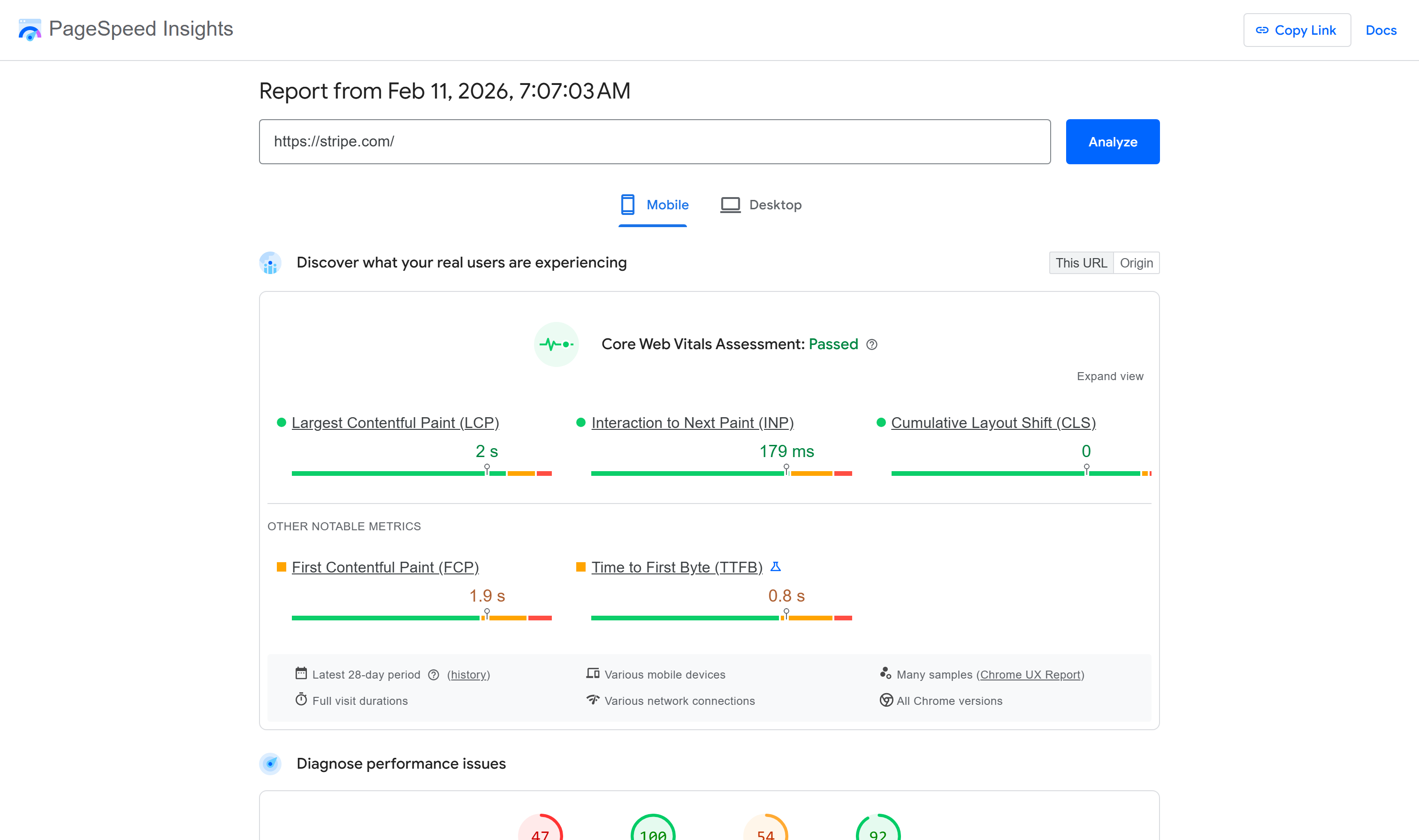
Image credit: Google PageSpeed Insights
For a step-by-step walkthrough of implementing these elements, see our DIY SEO guide for startup companies.
Building Your SEO Strategy
With the fundamentals in place, it's time to build a strategy. SEO strategy for startups follows a clear sequence: find the right keywords, create content around them, and build authority through backlinks.
Keyword Research for Startups
Keyword research is where your SEO strategy begins. The goal is to find terms your potential customers are searching for that you can realistically rank for.
You don't need expensive tools to start. These free resources cover the basics:
1. Google Search Console. If you have any existing traffic, Search Console shows you which queries people use to find your site. This is your most honest data source — real search terms, not estimates.
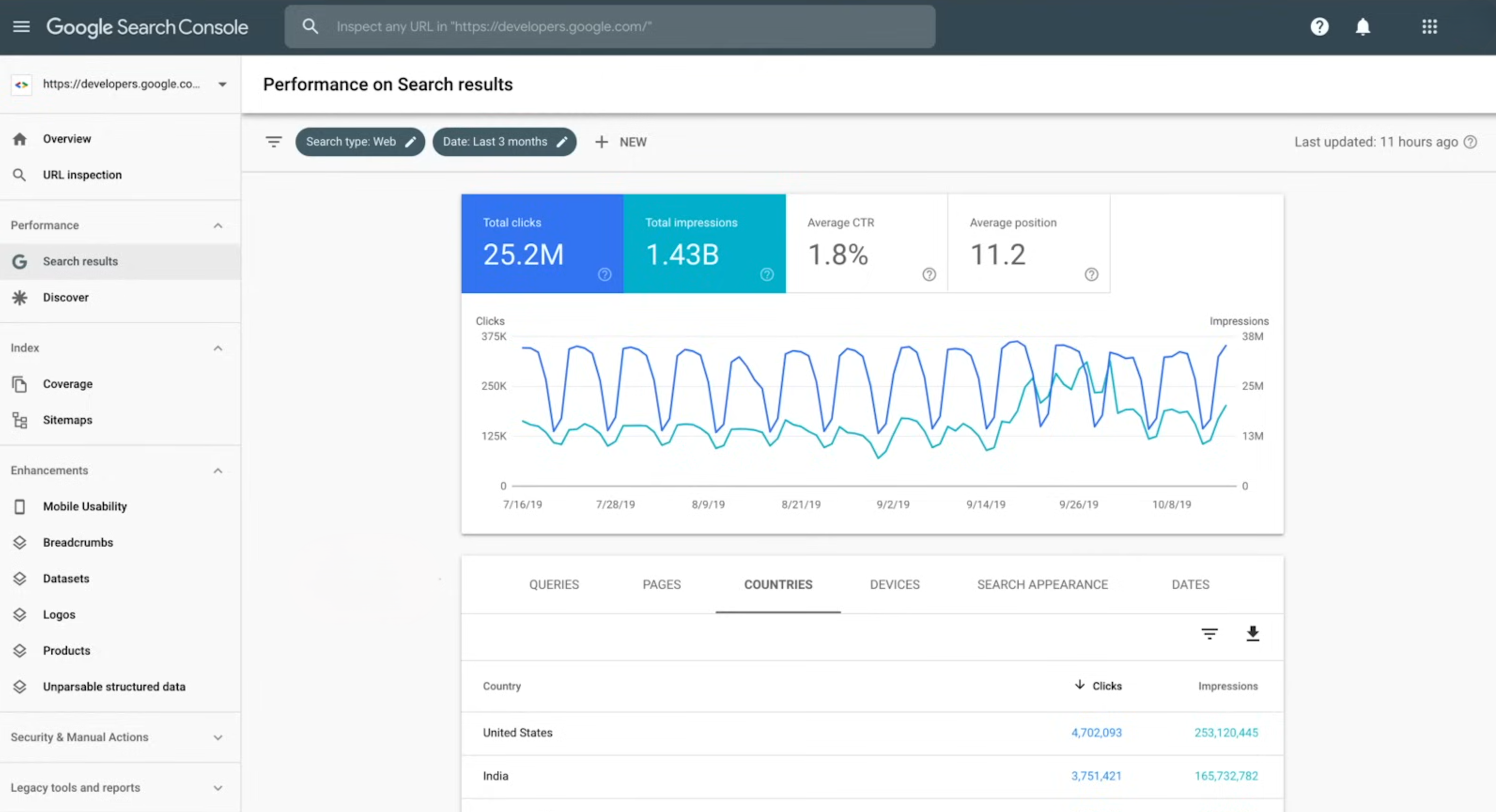
Image credit: Google Search Console
2. Google's "People Also Ask" and autocomplete. Type your core topic into Google and note the autocomplete suggestions and "People Also Ask" boxes. These are real queries people search for.
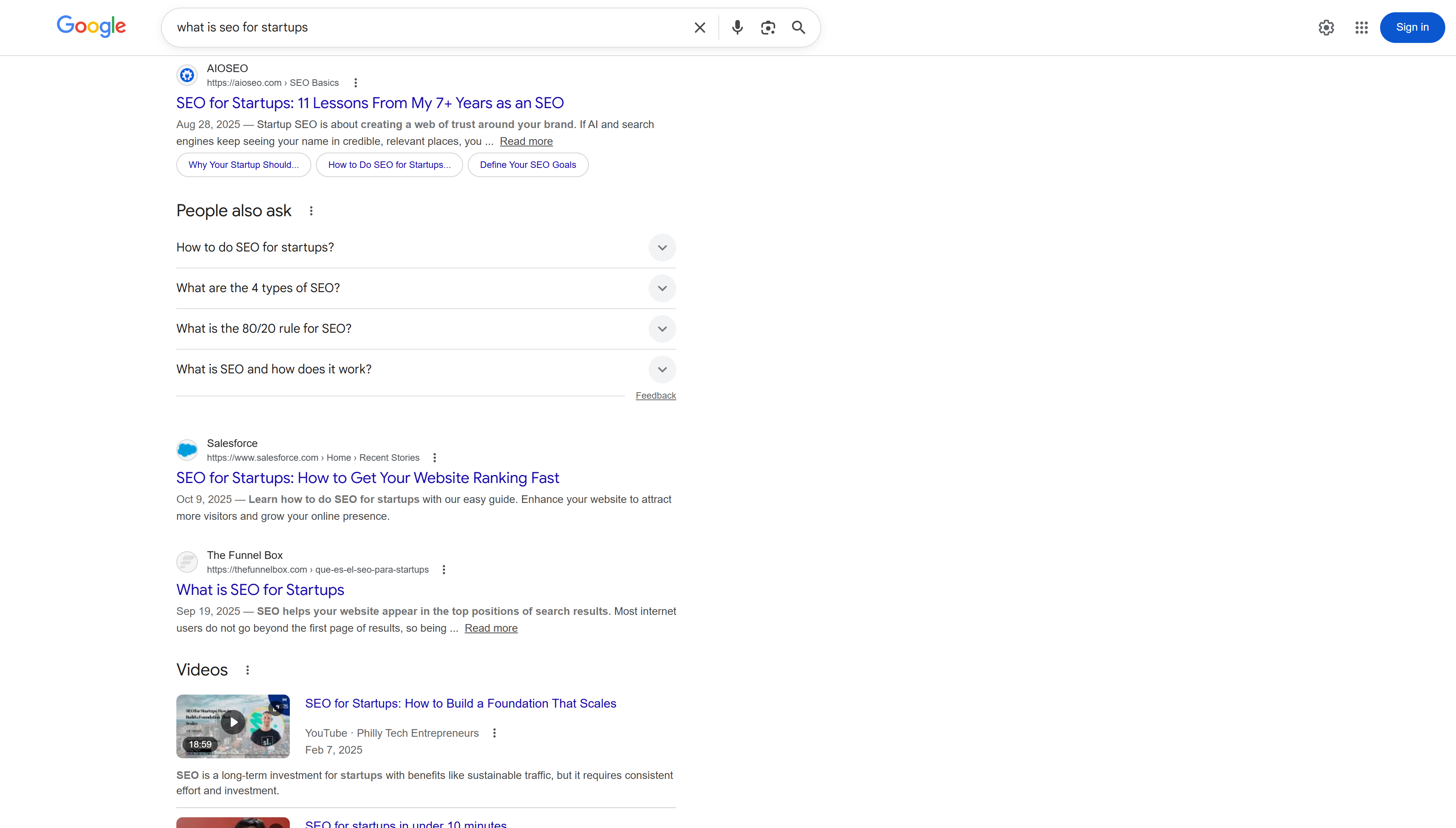
3. Reddit and forums. Search your product category on Reddit. The questions people ask are keywords. "How do I track time for freelance projects?" is a long-tail keyword opportunity hiding in plain sight.
4. Free tiers of SEO tools. Google Keyword Planner (free with a Google Ads account), Ubersuggest (limited free searches), and AnswerThePublic (limited free searches) provide volume estimates and related terms.
The long-tail strategy. For startups with new domains, targeting long-tail keywords is the fastest path to ranking:
| Keyword Type | Example | Monthly Volume | Competition | Startup Fit |
|---|---|---|---|---|
| Head term | "CRM software" | 50,000+ | Extreme | No |
| Mid-tail | "CRM for small business" | 5,000 | High | Later |
| Long-tail | "simple CRM for freelancers" | 500 | Low | Start here |
Target keywords with under 1,000 monthly volume and low-to-medium competition. These terms individually drive modest traffic, but 20-30 long-tail pages collectively can generate significant organic visitors.
Content Strategy: What to Write and How
Content is the engine of startup SEO. Without it, there's nothing to rank.
1. Build a topic cluster. Don't write random blog posts. Organize content around topic clusters — a pillar page (comprehensive guide) supported by cluster pages (specific subtopics) that all link back to the pillar.
Example cluster for a project management startup:
- Pillar: "The Complete Guide to Project Management for Remote Teams"
- Cluster 1: "How to Run Effective Remote Standups"
- Cluster 2: "Best Free Project Management Tools for Small Teams"
- Cluster 3: "Remote Team Communication: Async vs Real-Time"
- Cluster 4: "Project Management for Freelancers: A Simple Framework"
Each cluster page targets a specific long-tail keyword and links back to the pillar. This structure tells Google you have comprehensive expertise on the topic and helps all pages in the cluster rank higher.
2. Content quality checklist. Google's helpful content guidelines are clear: write for people first, search engines second. Every piece of content should pass this test:
- Does it answer the search query completely? Don't pad content for word count. A 1,200-word post that fully answers the question beats a 3,000-word post with filler.
- Does it provide unique value? If your post says the same thing as the top 10 results, Google has no reason to rank it. Add original data, frameworks, or perspectives.
- Is it written by someone with expertise? Google's E-E-A-T framework (Experience, Expertise, Authoritativeness, Trustworthiness) rewards content from people who actually know the topic.
- Is it structured for readability? Short paragraphs (2-4 sentences), clear headings, bullet points for lists, and tables for comparisons.
3. Content production cadence. For a startup with limited resources, consistency matters more than volume:
| Team Size | Recommended Cadence | Monthly Output |
|---|---|---|
| Solo founder | 1 post per week | 4 posts |
| 1 marketer | 2 posts per week | 8 posts |
| Small team (2-3) | 3-4 posts per week | 12-16 posts |
Start with 1 quality post per week. A single well-researched, well-written post outperforms 5 thin articles. After 3-6 months, you'll have 12-24 posts building organic traffic — enough to start seeing real results.
Link Building for New Domains
Backlinks remain one of Google's strongest ranking signals. For startups with new domains and zero backlinks, this is the hardest part of SEO — but there are practical approaches that don't require a budget.
1. Startup directories. Submit your startup to directories like Product Hunt, Crunchbase, G2, Capterra, and industry-specific listings. These provide legitimate backlinks and referral traffic.
2. Building in public. Sharing your startup journey on X (Twitter), LinkedIn, and Reddit naturally attracts links. When people reference your story or data, they link to your site.
3. Guest contributions. Write guest posts for industry blogs or contribute expert quotes to journalists. Tools like HARO (Help a Reporter Out) connect startups with journalists looking for sources.
4. Original data and research. Publish original data, surveys, or analysis. Content with unique data gets linked to far more than opinion pieces. Even simple analyses — "We surveyed 100 startup founders about their marketing budgets" — attract backlinks.
5. Broken link building. Find broken links on relevant websites (using free tools like Check My Links browser extension) and suggest your content as a replacement.
What to avoid:
- Buying links. Google explicitly penalizes paid link schemes. It's not worth the risk.
- Link exchanges. "I'll link to you if you link to me" schemes are detectable and can hurt rankings.
- Low-quality directories. Submit to reputable directories only. Spammy link farms do more harm than good.
For a detailed breakdown of SEO approaches including when to hire an agency, see our guide on SEO agencies vs DIY vs AI for startups.
Measuring SEO Success
Track these metrics monthly to understand if your SEO efforts are working:
| Metric | Tool | What It Tells You |
|---|---|---|
| Organic traffic | Google Analytics | Total visitors from search engines |
| Keyword rankings | Google Search Console | Which terms you rank for and where |
| Impressions | Google Search Console | How often you appear in search results |
| Click-through rate | Google Search Console | Percentage of impressions that result in clicks |
| Indexed pages | Google Search Console | How many of your pages Google has discovered |
| Backlinks | Ahrefs/Moz (free tier) | Number and quality of sites linking to you |
Realistic Timeline for Results
| Timeframe | What to Expect |
|---|---|
| Month 1-3 | Pages get indexed, minimal traffic, foundation building |
| Month 3-6 | Long-tail keywords start ranking, traffic slowly increases |
| Month 6-12 | Noticeable organic traffic growth, some keywords on page 1 |
| Month 12+ | Compounding growth, authority established, competitive terms start ranking |
Be patient but data-driven. If you're not seeing any indexing or impressions after 3 months, there's likely a technical issue. If you're getting impressions but no clicks, your titles and meta descriptions need work. If you're getting traffic but no conversions, your content doesn't match user intent.
Key Takeaways
- SEO is a startup's best compounding investment. Unlike paid ads that stop when you stop paying, every piece of content and optimization adds to your organic visibility over time.
- Start early, even before launch. Domain setup, keyword research, and basic structure cost nothing but give you a head start on the 6-12 month timeline for results.
- Master the fundamentals first. Understand search intent, nail on-page SEO basics, and complete your technical SEO checklist — these are mostly one-time setups that form the foundation for everything else.
- Follow a clear keyword and content strategy. Target long-tail keywords with low competition, organize content into topic clusters, and prioritize one quality post per week over five thin articles.
- Build backlinks with free strategies. Directories, building in public, guest contributions, and original data — link building takes time but compounds just like content.
- Measure monthly and stay patient. Track organic traffic, rankings, and impressions in Google Search Console. Expect 6-12 months before seeing meaningful results, but use data to diagnose and fix issues along the way.